
Echo Water® and Echo Ultimate™ are trademarks of their respective owner. This page is an independent comparison and is not affiliated with, endorsed by, or sponsored by Echo Water.
If you're looking for an alternative to Echo Water's machines — whether it's the price, the battery dependency on their portable line, or just wanting a more focused countertop unit — here's the direct case for HERO Dual 20 instead. If you're still weighing Echo's product line itself rather than looking to leave it, our Echo Water review covers that side first.
The core case for switching
Echo's strength is real: genuine SPE/PEM electrolysis, a bundled filtration stage on their flagship unit, and a 5-year warranty. None of that is in dispute. But it comes at a price — Echo Ultimate runs over $3,000 USD, against HERO Dual 20-1000 at $2,695 USD (A$3,883.49 AUD), for machines built on the same core electrolysis technology and a comparable concentration range.
If what you actually want is a dedicated hydrogen infusion machine — not a combined filtration-plus-hydrogen appliance — you may be paying for a feature (Echo's built-in tap-water filtration stage) you don't need if you already run distilled or filtered water into your machine, which HERO Dual 20 requires regardless.
What you gain switching to HERO Dual 20
- Lower upfront cost for a machine using the same underlying SPE/PEM electrolysis principle as Echo's countertop line.
- No battery to manage. Echo's portable Flask line depends on a rechargeable battery — a real convenience for travel, but a genuine point of failure and a maintenance step (charging, battery calibration periods, eventual battery degradation) that a plug-in countertop unit like HERO Dual 20 doesn't have.
- A single-purpose design. HERO Dual 20 is built specifically for hydrogen infusion, not bundled with a general filtration stage — if your water source is already handled separately, you're not paying for filtration hardware twice.
What you'd be giving up
Worth being direct about this: Echo Ultimate's built-in filtration and longer 5-year warranty are genuine advantages if either matters to your decision. If you want one appliance that handles both tap-water filtration and hydrogen infusion, or you specifically value a longer warranty term, Echo's flagship remains a legitimate choice — this isn't a claim that HERO Dual 20 is strictly better in every respect, only that it's a more focused, lower-cost alternative for a specific use case.
If built-in filtration is the part you don't want to give up, the closer match in our range is the HERO Purity 200-110 — a reverse-osmosis system with 3-stage PP/CTO/RO filtration ahead of a PEM cell, rated up to 2,500 ppb dissolved hydrogen. It's a water-only machine with no inhalation function, so it's the filtration-first alternative rather than a like-for-like swap for HERO Dual 20. The rest of the water range sits on the RO systems hub.
The switch, by the numbers
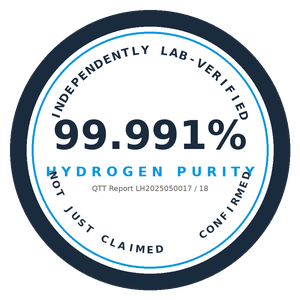
Both HERO and Echo Water use similar electrolysis-based technology, which is inherently free of ozone and mixed-gas byproducts — that's a property of the technology, not a HERO-specific claim. What is different is verification: HERO's purity figures come from an independent lab report you can ask to see. Most competitor pages, including Echo Water's, state a purity percentage with no named lab or report behind it.
HERO purity reports: LH2025050017 · LH2025050018
Echo Ultimate vs HERO Dual 20-1000
Comparison based on manufacturer-published engineering specifications.
Comparison based on manufacturer-published engineering specifications. Hydrogen Machines products are general wellness devices; certifications and specifications describe hardware and manufacturing, not medical or therapeutic status.
HERO Dual 20-1000 pricing is pulled live from our product catalogue. The HERO Dual 20 concentration cell is intentionally a placeholder pending a verified tested figure — no invented number is inserted here.
For the fuller side-by-side — including the measurement-point caveats behind any dissolved-hydrogen claim — see our Echo Ultimate vs. HERO Dual 20 comparison.
Making the switch
If you want a dedicated, lower-cost hydrogen infusion machine and don't need built-in tap-water filtration, HERO Dual 20-1000 is the direct alternative. For the fuller technical picture of how PEM electrolysis works and what to look for in any hydrogen water machine, see our hydrogen water machine guide.