
Vital Reaction® is a registered trademark of its respective owner. This page is an independent comparison and is not affiliated with, endorsed by, or sponsored by Vital Reaction.
If you're looking for an alternative to Vital Reaction's hydrogen tablets — whether it's the recurring cost, the reliance on whatever water source is on hand, or just wanting a machine instead of a consumable — here's the direct case for switching to a one-time-purchase hydrogen water machine instead. If you're still weighing the tablets themselves rather than looking to leave them, our Vital Reaction review covers that side first.
The core case for switching
Tablets solve a real problem well: zero setup, fully portable, works anywhere. But they solve it by being a consumable you never stop buying. Vital Reaction's own product pages confirm a 60-tablet bottle at $59.50 USD, with recommended use of 1–2 tablets a day — that's roughly a bottle a month, or about $720 USD a year, indefinitely, for as long as you keep using them.
A drinking-water machine flips that: one purchase, then no per-glass cost, ever. Our HERO Dual 20-1000 is $2,695 USD (A$3,883.49 AUD) — at the same daily usage tablets assume, that's a break-even around 3.7 years, and every year of use after that is functionally free by comparison. By year 5, tablet spend has already run past the machine's one-time cost and keeps climbing every year after with no ceiling.
What you gain switching to a machine
- No recurring cost after the initial purchase. The single biggest practical difference — a tablet habit never stops costing money; a machine purchase does.
- A controlled water source. HERO Dual 20 runs on distilled/demineralized water specifically, which means the input going into your hydrogen water is consistent and known — not whatever tap, filtered, or bottled water happened to be on hand when you dropped a tablet in.
- No open-cup dissolution to manage. Tablets react in open water, and dissolved hydrogen starts escaping the moment the reaction finishes — published dissipation data puts the half-life of dissolved H₂ in an open container at roughly two hours. A machine producing water on demand shortens that gap between generation and drinking.
What you'd be giving up
Fair to say plainly: tablets are genuinely better for travel, for occasional use, or if you don't want a countertop appliance at all. If portability matters more to you than long-run cost, a machine isn't a strict upgrade — it's a different tool for a different pattern of use. This page is for the specific case of someone who's decided daily, at-home use is their pattern, and wants out of the recurring-purchase cycle that comes with it.
HERO Inhaler 1200
The HERO inhaler tier this comparison is built around.
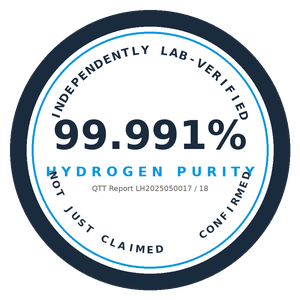
Both HERO and Vital Reaction use similar electrolysis-based technology, which is inherently free of ozone and mixed-gas byproducts — that's a property of the technology, not a HERO-specific claim. What is different is verification: HERO's purity figures come from an independent lab report you can ask to see. Most competitor pages, including Vital Reaction's, state a purity percentage with no named lab or report behind it.
HERO purity reports: LH2025050017 · LH2025050018
The switch, by the numbers
Comparison based on manufacturer-published engineering specifications.
Comparison based on manufacturer-published engineering specifications. Hydrogen Machines products are general wellness devices; certifications and specifications describe hardware and manufacturing, not medical or therapeutic status.
HERO Dual 20-1000 price is pulled live from our product catalogue. Vital Reaction tablet cost figures ($59.50/bottle, ~$720/year) are sourced directly from Vital Reaction's own current product pages and are not dynamic.
The claimed hydrogen concentration for both formats is a separate question from cost — Vital Reaction's 8–10 ppm figure and the physical solubility ceiling behind it are covered in full, with sources, on our tablets vs. machines comparison. This page is specifically about the cost-and-consistency case for switching, not a re-litigation of the concentration debate.
Making the switch
If daily hydrogen water is part of your routine and you're tired of reordering, HERO Dual 20-1000 is the direct one-time alternative. For the fuller technical picture — including how PEM electrolysis works and what to look for in any hydrogen water machine, not just ours — see our hydrogen water machine guide.