
What this guide covers.
This guide is written for US buyers considering a hydrogen inhaler for home use in 2026. It covers:
- What to look for in a hydrogen inhaler before purchasing
- The certification minimum for a machine sold and used in the US
- A side-by-side comparison of the full HERO range available to US buyers
- Which HERO machine suits which use case, on the same criteria
- How US buyers can purchase direct with free delivery and duties included
We have been selling hydrogen machines online since 2021. The specifications and certifications we publish are verified and documented — not estimated. Every figure in the comparison below is read directly from our product catalogue.
What to look for — five criteria.
Apply these five criteria to any machine you are considering. They separate machines that are engineered correctly from those that are not.
1. PEM/SPE electrolysis — not alkaline
The electrolysis technology determines gas purity, safety and maintenance requirements. PEM/SPE — Proton Exchange Membrane / Solid Polymer Electrolyte — is the correct technology for a daily-use consumer inhaler. It produces separated gas streams and 99.991% pure hydrogen without corrosive chemicals. Alkaline electrolysis using lye electrolytes is an industrial production method not appropriate for a device you breathe from daily. See our guide on PEM electrolysis explained.
2. Published purity — 99.991% H₂
99.991% pure hydrogen at the hydrogen outlet is the standard a correctly engineered PEM/SPE machine achieves. This figure should appear on the specification sheet — not be implied by marketing language. If a seller does not publish a purity figure, request it in writing before purchasing.
3. FCC certification for US buyers
FCC certification confirms the device meets US federal radio frequency emission standards — required for electronic devices sold in the United States. This is the US-specific certification criterion that goes beyond the CE baseline. All HERO Inhaler & HERO Inhaler Pro series machines carry FCC alongside CE, RoHS, ISO 9001 and ISO 13485 — the fullest certification stack available on any hydrogen inhaler at direct price. These certifications describe the hardware and manufacturing — not therapeutic or medical status.
4. Certified flow rate — ml/min
Flow rate determines how much hydrogen is delivered per session. It should be a certified figure in ml/min — not a marketing estimate. Always confirm whether the quoted figure is pure H₂ output or combined H₂+O₂ total output. In a correctly separated 2:1 system, pure H₂ is always two-thirds of the combined total. See how flow rate determines your dose.
Individual Dosage and Delivery
HERO Inhaler systems ship with a nasal cannula as standard; a facemask can also be used if preferred. Because delivery interface affects safe flow-rate calibration, our published per-person flow rates are calibrated for cannula delivery — the configuration most users actually use — targeting an average Fraction of Inspired Hydrogen (FiH2) of approximately 2%, consistent with nasal cannula guidance in the peer-reviewed physiological modeling of hydrogen inhalation (LeBaron et al., 2026). This target is set with deliberate margin below the 4% flammability threshold, accounting for the natural variation between average and instantaneous concentration that occurs with cannula delivery.
Every HERO Inhaler model — including our higher-capacity dual-user systems — delivers this same calibrated per-person flow, whether used by one person or two simultaneously. A higher total model number reflects capacity for more simultaneous users, not a higher dose to a single person.
Combined H2+O2 mode is also available on PEM/SPE systems like HERO Inhaler — a genuine advantage over alkaline (Brown's Gas) electrolysis, which is not appropriate for human inhalation at all due to contamination risk from its open liquid electrolyte. Because a stoichiometric H2+O2 mixture is more reactive than H2 diluted in ambient air, combined mode is delivered at a correspondingly lower, more conservative flow rate than pure H2 mode — engineered specifically for that mode's different safety profile, not a limitation.
| Model | Pure H2 flow (per person) | User capacity | Delivery |
|---|---|---|---|
| HERO Inhaler 900 | 600 ml/min | 1 users | Nasal cannula (facemask optional) |
| HERO Inhaler 1200 | 800 ml/min | 2* users — with the dual cannula accessory | Nasal cannula (facemask optional) |
| HERO Inhaler 1500 | 1,000 ml/min | 2 users | Nasal cannula (facemask optional) |
| HERO Inhaler 2000 | 1,200 ml/min | 2* users — with the dual cannula accessory | Nasal cannula (facemask optional) |
| HERO Inhaler Pro 3000 | 2,000 ml/min | 2 users | Nasal cannula (facemask optional) |
5. US support and FDA position
Confirm the seller can support US buyers directly — warranty claims, returns and pre-purchase questions. Also confirm the machine is marketed correctly under the FDA's General Wellness Policy for Low Risk Devices — not as a medical device, and with no disease or treatment claims. A seller making clinical claims about a hydrogen inhaler in the US market is operating outside the FDA's general wellness framework.
Why HERO machines are the best hydrogen inhalers in the USA.
Documented purity, not implied purity. Every HERO inhaler publishes its hydrogen purity as a specification figure, backed by independent purity certificates rather than marketing language.
The fullest certification stack at direct price. The HERO Inhaler and HERO Inhaler Pro series carry CE, FCC Part 15 Subpart B, RoHS, ISO 9001 and ISO 13485, with the test report published rather than merely referenced. These certifications describe hardware and manufacturing — not therapeutic or medical status.
Honest flow-rate reporting. We publish pure H₂ output alongside combined H₂+O₂ output for every machine, so the number you compare is the number you breathe.
A complete range, one chassis philosophy. From the portable HERO Inhaler Go through to the dual-user HERO Inhaler Pro 3000, the range covers solo daily sessions, households, extended sessions and multi-user rooms — plus the HERO Dual 20 for buyers who want inhalation and hydrogen water from one machine.
Direct pricing with US delivery and duties included. No distributor margin, no subscription programme, no bundled content. You are paying for the machine.
All HERO products are marketed strictly as general wellness devices under the FDA's General Wellness Policy for Low Risk Devices. We make no disease or treatment claims.
The HERO lineup compared.
Comparison based on manufacturer-published engineering specifications.
Every machine we sell into the US, side by side, on the same criteria. Specifications, certifications and prices are read directly from our product catalogue, so the figures below always match the product pages. Prices are USD, direct, with delivery and duties included.
| Specification |  Portable entry |  Solo daily use |  Two users |  Extended sessions |  High-frequency use | 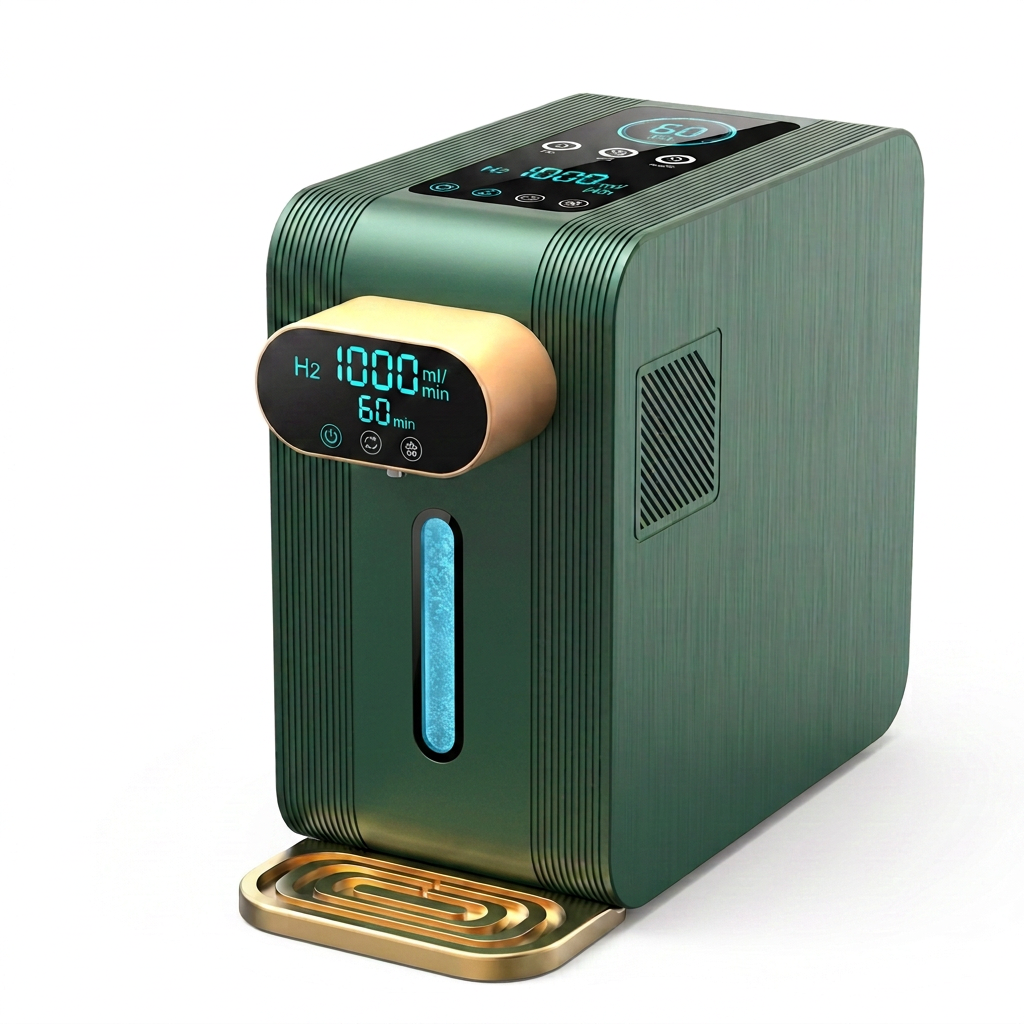 Inhalation + H₂ water |  Flagship · multi-user | RO water system — not an inhaler |
|---|---|---|---|---|---|---|---|---|
| Purity Level / Output Concentration | 99.992% H₂ (published) | 99.991% H₂ (published) | 99.991% H₂ (published) | 99.991% H₂ (published) | 99.991% H₂ (published) | ≥99.992% H₂ (inhalation) | 99.991% H₂ (published) | Low-TDS purified water for inhaler reservoirs |
| Membrane / Electrolysis Technology | PEM/SPE membrane electrolysis | PEM/SPE membrane electrolysis | PEM/SPE membrane electrolysis | PEM/SPE membrane electrolysis | PEM/SPE membrane electrolysis | PEM/SPE membrane electrolysis (inhalation + H₂ water) | PEM/SPE membrane electrolysis | Reverse-osmosis water purification — no hydrogen output |
| Certification | CE | CE · FCC Part 15B · RoHS · ISO 9001 · ISO 13485 | CE · FCC Part 15B · RoHS · ISO 9001 · ISO 13485 | CE · FCC Part 15B · RoHS · ISO 9001 · ISO 13485 | CE · FCC Part 15B · RoHS · ISO 9001 · ISO 13485 | CE | CE · FCC Part 15B · RoHS · ISO 9001 · ISO 13485 | CE · RoHS |
| Price | $2,050 USD | $2,877 USD | $3,293.38 USD | $3,709.76 USD | $4,264.93 USD | from $2,695 USD | $5,697 USD | $1,750 USD |
| Availability | In stock — ships to the US | In stock — ships to the US | In stock — ships to the US | In stock — ships to the US | In stock — ships to the US | In stock — ships to the US | In stock — ships to the US | In stock — ships to the US |
| Pure H₂ Output | 660 ml/min (1,000 ml/min combined) | 600 ml/min (900 ml/min combined) | 800 ml/min (1,200 ml/min combined) | 1,000 ml/min (1,500 ml/min combined) | 1,333 ml/min (2,000 ml/min combined) | 667 / 1,000 / 1,333 ml/min + H₂ water | 2,000 ml/min (3,000 ml/min combined) | None — water system, not an inhaler |
| Customer Rating | ★ 5.0 / 5 (1 review) | ★ 5.0 / 5 (1 review) | ★ 5.0 / 5 (1 review) | ★ 5.0 / 5 (1 review) | ★ 5.0 / 5 (1 review) | No customer reviews yet | ★ 5.0 / 5 (1 review) | No customer reviews yet |
| FDA Position | General wellness device | General wellness device | General wellness device | General wellness device | General wellness device | General wellness device | General wellness device | General wellness device |
All specifications, certifications and USD prices are read from our product catalogue and match the individual product pages. HERO Purity 200-110 is a reverse-osmosis water system, not an inhalation device — it is included because water quality determines PEM stack service life. Certifications describe hardware and manufacturing, not medical or therapeutic status.
Our recommendations for US buyers.
Best first machine — HERO Inhaler Go Hydrogen Inhaler
The HERO Inhaler Go is the lowest-friction entry point into hydrogen inhalation for US buyers — 660 ml/min pure H₂ (1,000 ml/min combined H₂+O₂), CE certified, simple one-button operation. At $2,050 USD with free delivery and duties included, it delivers documented, certified output at a direct price. If FCC Part 15 Subpart B compliance is a priority for you, step up to the HERO Inhaler 1200.
$2,050 USD — View HERO Inhaler Go →
Best for daily home use (FCC Part 15 Subpart B compliant) — HERO Inhaler 1200 Hydrogen Inhaler
The HERO Inhaler 1200 is our most recommended machine for US buyers who want the fullest certification stack. All HERO Inhaler & HERO Inhaler Pro series machines carry CE, FCC Part 15 Subpart B, RoHS, ISO 9001 and ISO 13485 — FCC Part 15 Subpart B compliance confirms the device meets US federal electromagnetic emission limits for unintentional radiators (Certificate No. LST250598095F, ANSI C63.4:2014, issued 30 May 2025). The HERO Inhaler 1200 supports dual cannula use for two users simultaneously. At $3,293.38 USD direct with free delivery, it pairs the fullest published certification documentation in the HERO range with a mid-tier flow rate suited to daily household sessions.
$3,293.38 USD — View HERO Inhaler 1200 →
Best for inhalation + hydrogen water — HERO Dual 20 Inhale + Drink All-in-One
The HERO Dual 20 produces both inhalation output (pure H₂ across three variants: 667 / 1,000 / 1,333 ml/min) and hydrogen-rich water (≥3,000 ppb) simultaneously from a single machine. For US buyers who want both delivery routes without two separate devices, the HERO Dual 20 is the direct-price solution, from $2,695 USD.
from $2,695 USD — View HERO Dual 20 →
Best for high-frequency use and clinics — HERO Inhaler 2000 Hydrogen Inhaler
The HERO Inhaler 2000 delivers 1,200 ml/min pure H₂ and 2,000 ml/min total output. If you need more, the HERO Inhaler Pro 3000 delivers 2,000 ml/min pure H₂ (3,000 ml/min combined) — the highest in the range. For US wellness clinics, practitioners or users running extended daily sessions, this is the machine. Direct pricing with free delivery and duties included, with the full CE · FCC · RoHS · ISO 9001 · ISO 13485 certification stack.
$4,264.93 USD — View HERO Inhaler 2000 →
Best for multi-user rooms — HERO Inhaler Pro 3000 Hydrogen Inhalation Machine
The HERO Inhaler Pro 3000 is the flagship of the range: 2,000 ml/min pure H₂ (3,000 ml/min combined H₂+O₂) across two independent outlets, so two people can run a session at once. It carries the same CE · FCC Part 15 Subpart B · RoHS · ISO 9001 · ISO 13485 stack as the rest of the HERO Inhaler series. Intermediate flow tiers are available if the Pro is more machine than you need — the HERO Inhaler 900 and HERO Inhaler 1500 sit between the entry and studio tiers on the same chassis.
$5,697 USD — View HERO Inhaler Pro 3000 →
Water input for any inhaler — HERO Purity 200-110
Every PEM inhaler in this comparison depends on the water you feed it. The HERO Purity 200-110 is a reverse-osmosis water system that supplies consistently low-TDS water for inhaler reservoirs, which protects the membrane stack over the machine's service life. It is not an inhalation device and produces no hydrogen gas for breathing — it is included here because water quality is the single most common cause of premature PEM stack failure in US households.
$1,750 USD — View HERO Purity 200-110 →
Hydrogen System Decision Tree
Step 1 — What routine do you want?
- Seated, structured → Inhalation
- If inhalation → How many people?
- One person → HERO 900 / 1200
- Two people → HERO 1500 / 1800 / Pro 3000
- Want flexibility? → HERO 1200 or HERO 1500
- Warm-water relaxation → Bathing
- If bathing → How often?
- 1–3× weekly → Standard capacity
- Daily/shared → Higher capacity
- Spa/clinic → Premium capacity
- If both → Combine systems
- Inhalation model based on user count
- Bath model based on frequency
A note on FDA position for US buyers.
Hydrogen inhalers are not FDA-approved medical devices. They are marketed as general wellness devices under the FDA's General Wellness Policy for Low Risk Devices.
This means:
- No disease or treatment claims can legally be made
- The machines do not require FDA clearance or approval to be sold in the US
- Sellers making disease-specific claims about hydrogen inhalers are operating outside the FDA framework
All Hydrogen Machines products are marketed strictly as general wellness devices. We make no claim to diagnose, treat, cure or prevent any disease or medical condition. We encourage US buyers to be cautious of any seller making clinical or disease-specific claims about hydrogen inhalers — these are not substantiated and may indicate the seller is operating outside regulatory guidelines.
Hydrogen gas is recognised as Generally Recognized As Safe (GRAS) by the US FDA.
What to avoid.
Amazon listings without certification documentation — machines sold through Amazon.com with CE logos but no published certificate documents. Specifications on these listings are frequently unverified. Price alone is not a reliable guide.
Alkaline electrolysis machines — any machine requiring potassium hydroxide or sodium hydroxide as an electrolyte is using alkaline electrolysis. Not appropriate for daily consumer inhalation regardless of other claims.
Sellers making disease or treatment claims — any US seller stating their hydrogen inhaler treats, cures or prevents a specific condition is making claims outside the FDA General Wellness framework. This is a red flag for both regulatory compliance and credibility.
Subscription bundles without published hardware specs — premium US wellness brands that bundle machines with monthly content subscriptions frequently do not publish certified hardware specifications. You are paying for the programme, not the machine.
Frequently asked questions
What's the difference between PEM/SPE and alkaline hydrogen inhalers?
PEM/SPE (Proton Exchange Membrane / Solid Polymer Electrolyte) technology produces separated gas streams and 99.991% pure hydrogen without corrosive chemicals, making it the correct choice for daily inhalation. Alkaline electrolysis uses a lye electrolyte and is an industrial production method — not appropriate for a device used for daily breathing.
What purity figure should a hydrogen inhaler publish?
A correctly engineered PEM/SPE machine should publish 99.991% pure hydrogen at the outlet as a documented specification — not an implied marketing figure. If a seller doesn't publish a purity figure, request it in writing before purchasing.
Is FCC certification required for a hydrogen inhaler sold in the US?
FCC certification confirms a device meets US federal radio frequency emission standards, which is required for electronic devices sold in the United States. It goes beyond the CE baseline used in other markets and is a US-specific criterion to check before buying.
How is flow rate measured, and what should I check?
Flow rate should be a certified figure in ml/min, not a marketing estimate. Always confirm whether the quoted number is pure H₂ output or combined H₂+O₂ total output — in a correctly separated 2:1 system, pure H₂ is two-thirds of the combined total.
Are hydrogen inhalers FDA-approved medical devices?
No. Hydrogen inhalers are marketed as general wellness devices under the FDA's General Wellness Policy for Low Risk Devices. They do not require FDA clearance or approval to be sold in the US, and no disease or treatment claims can legally be made about them.
What should I avoid when buying a hydrogen inhaler in the US?
Avoid Amazon listings without published certification documentation, alkaline electrolysis machines, sellers making disease or treatment claims, and subscription bundles that don't publish certified hardware specifications.
FCC Part 15 Subpart B — independent laboratory testing
CE certification is the European standard and the baseline for any hydrogen inhaler sold globally. FCC Part 15 Subpart B is the US electromagnetic compliance standard — and unlike CE it requires independent laboratory testing, not self-declaration.
5 machines in our range carry FCC Part 15 Subpart B compliance in addition to CE: HERO Inhaler 900, HERO Inhaler 1200, HERO Inhaler 1500, HERO Inhaler 2000 and HERO Inhaler Pro 3000. Certificate LST250598095F. Full 21-page test report downloadable at certifications →.
Ask any hydrogen inhaler seller for their equivalent documentation before purchasing.
Read more.
This page is editorial content. Competitor specifications are sourced from publicly published product pages and are accurate to the best of our knowledge at the date of publication. Hydrogen Machines products are general wellness devices marketed under the FDA's General Wellness Policy for Low Risk Devices. Not medical devices. No claim is made to diagnose, treat, cure, or prevent any disease or medical condition.