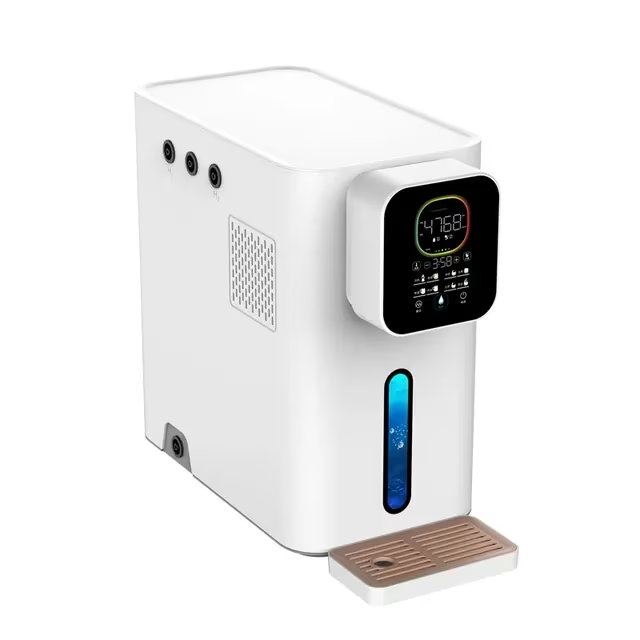
Drinking hydrogen water and breathing hydrogen gas are the two most common ways people take molecular hydrogen (H₂). They're often compared as if one simply beats the other. The research tells a more useful story: the two routes enter the body in different places, deliver very different amounts of hydrogen, and reach different organs first.
The short answer
- Inhalation delivers far more hydrogen. A 15-minute session supplies roughly 200 times the hydrogen in a daily litre of hydrogen water.
- Drinking sends hydrogen to the gut and liver first. Most of it is taken up there before it reaches the rest of the body.
- Inhaled hydrogen goes straight into general circulation. It reaches muscle and the brain more readily and stays raised for as long as you breathe it.
- Skin can absorb hydrogen too, from a hydrogen-rich bath, though the evidence is still early.
The Molecular Hydrogen Institute puts it simply: hydrogen water and hydrogen inhalation are not interchangeable dosing models.
Entry point 1: the lungs
The lungs are built for gas exchange. Their inner surface is around 70 square metres, and the membrane between air and blood is less than a thousandth of a millimetre thick. Hydrogen is the smallest molecule there is, so it crosses into the blood almost instantly.
From the lungs, blood goes to the heart and is pumped straight out through the arteries to the whole body: brain, heart muscle, skeletal muscle and every other organ. Nothing filters it first.
A 2020 study at Keio University measured this directly in pigs (Sano et al., PLOS ONE). After a single breath of hydrogen, levels in arterial blood peaked immediately and then fell to about one-fortieth within three minutes. Venous blood held hydrogen longer, as tissues released it back into circulation. The researchers concluded that inhaled hydrogen is carried by the bloodstream to the whole body.
That fast fall is why inhalation is done over a session rather than in a breath: blood levels stay raised for as long as you keep breathing hydrogen, and settle back within minutes after you stop. Much of the hydrogen you inhale is breathed out again. What matters is the concentration reached in the blood and how long it is held there.
Entry point 2: the gut and the liver
When you drink hydrogen water, hydrogen diffuses from the stomach and intestine into the surrounding blood vessels. That blood doesn't go to the general circulation. It drains into the portal vein, which carries everything absorbed from the gut to the liver first.
A second Keio University pig study (Ichihara et al., Heliyon, 2021) measured what happens next. After 500 ml of a hydrogen-rich solution, hydrogen in portal blood peaked at 0.05 mg/L and stayed raised for more than an hour, but it was not detected in arterial blood. In the earlier inhalation study, the same team estimated that the liver takes up around 64% of the hydrogen in portal blood as it passes through.
Their conclusion: drinking a concentrated hydrogen-rich solution quickly is a good way to raise hydrogen in portal blood and supply it to the liver. The gut, liver, pancreas and spleen get the most; much less travels further.
Entry point 3: the skin
A 2023 study (Iwai et al., Archives of Medical Science – Civilization Diseases) bathed a hairless pig, whose skin closely resembles human skin, in hydrogen-rich hot water. Hydrogen in the inferior vena cava rose steadily, from near zero to about 46 ppb after 20 minutes. The study used only two pigs, so it's a first measurement rather than settled evidence. But it shows hydrogen-rich bathing is a third real route into the blood.
How much hydrogen each route supplies
Water can only hold so much hydrogen. Even fully saturated at normal pressure it holds about 1.6 mg per litre, and some escapes before and after you drink it. The International Hydrogen Standards Association uses 0.5 mg in a litre a day as its benchmark for hydrogen water.
Gas has no such ceiling. Dr Grace Russell (University of the West of England) estimates that 15 minutes of pure hydrogen at 100 mL per minute supplies 90–135 mg.
| Route | Typical amount supplied | Source |
|---|---|---|
| Hydrogen water, 1 litre a day | about 0.5 mg (IHSA benchmark) | IHSA, via Russell |
| Hydrogen water, saturated | up to about 1.6 mg per litre | Russell et al., Hydrogen, 2021 |
| Inhalation, 15 min at 100 mL/min pure H₂ | about 90–135 mg | Russell, Hydrogen Health Network |
That's roughly 180 to 270 times more hydrogen per session than a daily litre of hydrogen water (our calculation from Dr Russell's figures). The amount any inhaler supplies depends on its hydrogen output and how long you use it.
Where hydrogen ends up
A 2014 rat study (Liu et al., Scientific Reports) measured hydrogen in tissues after different routes. Drinking hydrogen-rich water raised levels quickly, peaking in about five minutes, with the highest levels in the liver, kidney, spleen, pancreas and intestine. Inhaled hydrogen rose more slowly, peaking around 30 minutes, gave significantly higher levels in muscle and slightly higher levels in the brain, and stayed raised for at least 60 minutes.
| Measure | Drinking hydrogen water | Inhaling hydrogen |
|---|---|---|
| Enters through | stomach and intestine | lungs |
| First stop | liver, via the portal vein | heart, then the whole body via the arteries |
| Highest levels seen in | liver, kidney, spleen, pancreas, intestine | muscle, brain |
| Timing | fast peak, then declines | holds steady while you breathe it |
| Amount per session | under 2 mg | tens to over a hundred mg |
Dr Russell's rule of thumb matches this: hydrogen water mainly reaches the digestive system and its supporting organs, while inhalation tends to favour the heart, lungs and brain.
Does more hydrogen mean a better result?
Not necessarily, and the research is honest about that. Dr Russell notes that hydrogen may not follow a simple straight-line dose–response, so a larger dose isn't automatically better. The Molecular Hydrogen Institute points out that in some studies hydrogen water has been as effective as inhalation, and sometimes more so.
A six-month rat study (Xun et al., Scientific Reports, 2020) compared the two routes head to head and found most measured changes were much more pronounced with inhalation than with hydrogen water. It used healthy animals, though, so it shows the routes act differently, not that either treats anything.
Most of this research is in animals. It tells us how hydrogen moves through the body; it doesn't tell anyone what hydrogen will do for them.
Choosing a route, or using both
Because the routes reach different places, they're complementary rather than competing:
- Inhalation for the largest amount of hydrogen and steady levels in general circulation. See the HERO Inhaler range.
- Hydrogen water for hydrogen delivered to the gut and liver, through the day. See the HERO Bottle and HERO Purity 200-110.
- Both from one machine. The HERO Dual 20 and HERO RO Dual 10 produce hydrogen gas for inhalation and hydrogen water together.
- Bathing for absorption through the skin. See the HERO Bath.
FAQ
Is inhaling hydrogen better than drinking hydrogen water?
Inhalation delivers far more hydrogen, about 200 times more in a 15-minute session than a daily litre of hydrogen water, and reaches muscle and the brain more readily. Drinking delivers hydrogen to the gut and liver first. They reach different parts of the body, so neither simply replaces the other.
Where does hydrogen go after you drink hydrogen water?
It's absorbed from the stomach and intestine into the portal vein, which carries it to the liver. The liver takes up much of it, so the highest levels are in the liver, gut, pancreas, spleen and kidney.
Where does inhaled hydrogen go?
It crosses from the lungs into the blood within seconds, goes to the heart and is pumped through the arteries to the whole body without passing the liver first.
How long does hydrogen stay in the blood?
After inhalation, arterial levels fall within minutes once you stop, which is why sessions last 15 minutes or more. After drinking, portal blood levels in one pig study stayed raised for more than an hour.
Can hydrogen be absorbed through the skin?
Yes. A 2023 pig study measured hydrogen rising in the blood during a hydrogen-rich bath. It was a small study, so the evidence is early.
References
- Sano M, et al. Pharmacokinetics of a single inhalation of hydrogen gas in pigs. PLOS ONE, 2020. https://doi.org/10.1371/journal.pone.0234626
- Ichihara G, et al. Pharmacokinetics of hydrogen after ingesting a hydrogen-rich solution: a study in pigs. Heliyon, 2021. https://doi.org/10.1016/j.heliyon.2021.e08359
- Liu C, et al. Estimation of the hydrogen concentration in rat tissue using an airtight tube following the administration of hydrogen via various routes. Scientific Reports, 2014. https://doi.org/10.1038/srep05485
- Xun ZM, et al. Effects of long-term hydrogen intervention on the physiological function of rats. Scientific Reports, 2020. https://doi.org/10.1038/s41598-020-75492-w
- Iwai S, et al. Direct evidence of hydrogen absorption from the skin: a pig study. Archives of Medical Science – Civilization Diseases, 2023. https://amscd.termedia.pl/Direct-evidence-of-hydrogen-absorption-from-the-skin-a-pig-study,165963,0,2.html
- Russell G, Nenov A, Kisher H, Hancock JT. Molecular hydrogen as medicine: an assessment of administration methods. Hydrogen, 2021. https://doi.org/10.3390/hydrogen2040025
- Russell G. Molecular Hydrogen: Promise, Evidence, and Practical Reality. Hydrogen Health Network. https://hydrogenhealthnetwork.learnworlds.com/blog/hydrogen
- Molecular Hydrogen Institute. Hydrogen Water vs. Hydrogen Inhalation. https://molecularhydrogeninstitute.org/hydrogen-water-vs-hydrogen-inhalation/